
Back in the 90s when, as a teenager, I was first getting into green politics, it was often said that green would transcend the ‘grey’ politics of left and right. You don’t hear that much any more. Maybe we should. Is right-wing environmentalism part of the answer to the multiple ecological crises the world faces? Can we meaningfully create a consensus outside our socio-economic political differences and find ways to work together?
I’ve been thinking about this a lot recently because of a discussion on the topic I was part of. I will boil the conversation down to its two main arguments. The proposition, as it were, is that we exist in a bubble of other like-minded, progressive, evidence-led people while, in the wider world, people are falling for dishonest and divisive far-right rhetoric. It is as if we live in separate universes with entirely different understandings of reality. The counterargument is to acknowledge that people on the right also care about the environment – some of them, at least – and start to build a consensus that transcends the old left-right binary. You can have right-wing and left-wing environmental politics. Rightwing environmentalism might look like Tories caring about the countryside, for example, or eco-fascism, or a belief that capitalism will come up with a green technofix.
My immediate instinct was that right-wing environmentalism in any meaningful sense was impossible, but actually, it’s a strong argument. We do need to find some common ground since divide-and-rule tactics (aka ‘culture war’) are exactly how those in power are keeping us down. That common ground is perhaps already there since many far-right arguments take justified grievances as a starting point. And yes, of course people on the right can care about the environment. But can they have an environmental politics in the way we understand it on the Green Left, i.e. that addresses the scale of the problem and engages with the realities of how to live within our ecosystem? I don’t think so. And here’s why.
My theory of what makes an idea right-wing is that it’s based on sacrifice zones. Whether it’s the poor, the scapegoated, the colonised, factory workers or simply those without capital, what links people on the right is the idea that they think some lives are expendable. (You could also frame this in terms of hierarchies; the right thinks some lives have more value than others; that’s a potentially more nuanced way of saying the same thing.) This model also explains how easily some on the left drift rightwards; when they decide that dissidents need to be ‘disappeared’, for example, or that civilian casualties are a reasonable price to pay to keep a politically useful leader in power.
There are many ways of looking at our relationship with Nature, but they all really fall into two opposing camps: one defines Nature as everything outside the world of humans and human-made things. The other states that humans are very much part of Nature, co-existing with other beings in an ecosystem. The former suggests Nature is a backdrop to our lives and is there to be exploited or protected as we see fit. It’s a binary, human-centric model in which Nature is othered, and it is highly compatible with right-wing thought. In contrast, the ecological model understands how we are part of a complex ecology which is fundamental to our existence. There is no ‘other’. This view, I’d suggest, isn’t compatible with right-wing ideas. It’s a profoundly non-hierarchical worldview in which nothing is expendable. It has ‘no sacrifice zones’, to quote Naomi Klein.
Green Left politics not only takes the radical idea that no humans should be treated as justified sacrifices and applies it to the more-than-human world, but it also replaces the human/Nature binary with an understanding that we exist in a complex and profoundly interconnected ecosystem. What follows logically from that is truly transformative thinking. We must create new systems – including new value systems – that understand our profound ecological connectedness, our place within the global ecosystem, and the fragility of the ecological balance that keeps us alive. It’s very specifically the failure to do this, as a direct result of right-wing modes of thought, that has brought us to the crisis point where we find ourselves today. The idea of environmental justice, which inextricably links protection of the environment to social and economic justice, isn’t really possible within a rightwing intellectual framework, nor is the necessary levelling out of power and wealth.
This leaves a very simple conclusion. Right-wing environmentalism can only go so far, and that ‘far’ is nowhere near enough. It might enable us to find some common ground on which to start a discussion and maybe even change some minds. It might enable us to change some policies and protect some landscapes. But as long as people are stuck in right-wing worldviews, there’s a profound limit to their environmentalism, which cuts them off from the radical thinking we need and makes addressing root causes impossible.
One final point. Going back to the original assertion, we do all, of course, live in the same universe and share many of the same thoughts and experiences. I have run arts workshops with a huge range of people over the years: people with widely varied backgrounds and levels of education and privilege, some of whom have fallen for far-right or conspiracist propaganda, some of whom are stuck in dogmas from old-school leftism, some of whom are not really engaged with politics at all. Out of all these people, I’ve hardly met anyone I didn’t end up having some kind of interesting conversation with, or who was incapable of engaging with big topics. We face massive problems, but being stuck in bubbles doesn’t have to be one of them.
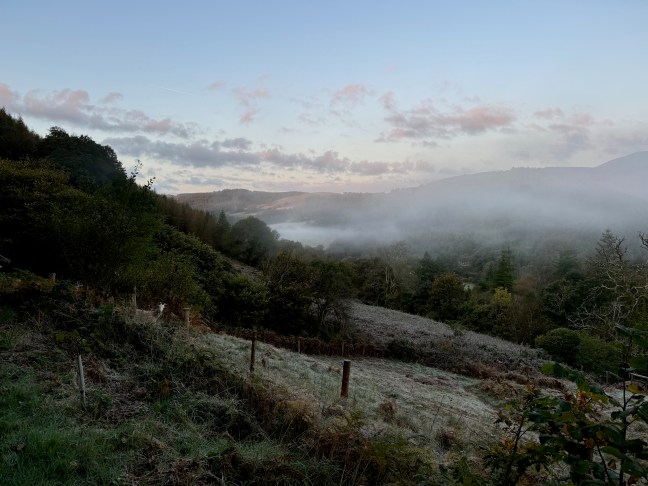
Picture: View (with goat) from above the Centre for Alternative Technology. By the author.

