Maybe AI can save us (by accident)

Given the rapid growth of generative AI and society’s addiction to manipulative, corporately controlled online platforms, you might think this is the end of skilled creativity. If anyone can make a film or a song or a novel in seconds, what’s left for skilled artists and craftspeople? 

Well, quite a lot, I think. 

Yes, we need to fight tooth and nail against the wholesale theft of our work by tech corporations, the loss of livelihoods, and the flooding of culture with soulless, vacuous simulacrums of creativity. Let alone the ecological damage and data harvesting. But I keep thinking about how MP3s and file sharing were going to kill live music, which has, in fact, flourished. At the time, it felt that, after the initial excitement waned, the ubiquity of downloads ended up increasing the value of in-person experience. 

AI is now a spectacle in both the everyday and Debordian senses of the word. But as it is revealed as a kind centripetal force, pushing culture into smooth unoriginality, it will, I believe, remind us of our profound need for human community and connection, and for originality, creativity and craft. It will increase the cultural value of things evidently made by humans, using their skill and expressing something original, meaningful and authentic. It will help us appreciate the rough edges – the grit in the oyster – which allow art to take us to new and challenging places; places we didn’t expect to go.

That is good in itself and gives me hope for the creative sector, both professional and participatory, whether it’s live performance, art manifestly made by human hands, author readings and book signings, craft workshops, communal music-making and dancing… All the myriad points of creative connection that help hold society together.

But I have another hope, too; that if more and more people step away from the circus of corporate spectacle, see the atomised, narcissistic and easily exploitable society it fosters, and seek meaning and fulfilment through human creativity – especially co-creativity – we may also find we’re nurturing the conditions needed for meaningful, radical political change.

Lost in Improvement: a Quick Postcript to My Previous Post

Further to my thoughts on the dangers of generative AI not just to our livelihoods but to how we relate to Nature in its broadest sense, I also want to flag up a smaller issue I have with this new technology. The biggest impact of AI in my working life so far has been improved captioning, and spelling and grammar checks. They’re still quite* inaccurate, but as someone who learned to do a lot of things the long way because there were no other options (or no other affordable options), I appreciate how hugely time-saving they are. I appreciate how much they’re improving. The inaccuracy matters, though.

Most generative AI suggestions are great reminders that fundamentally, what this tech is doing is taking an input, comparing it to other similar things, and suggesting an option that’s closer to commonly used patterns. You end up with a grammatically correct piece of text that, at best, has had its individuality sanded away and, at worst, means something entirely in contradiction to what you’re trying to say. In the case of Grammarly, for example, it offers to ‘improve’ your text, but really, it’s a kind of normalisation.

For transparency, I should say that I use Grammarly regularly, and its spelling and grammar checks are the best I’ve found, though I reckon I only accept 75-80% of the suggestions, and I’ve never been happy with the generative AI suggestions.

It’s the latter I want to highlight. I tried re-writing a paragraph from my previous post with Grammarly’s generative AI. Here’s the original:

Continue reading Lost in Improvement: a Quick Postcript to My Previous Post

Recent and Current Reading

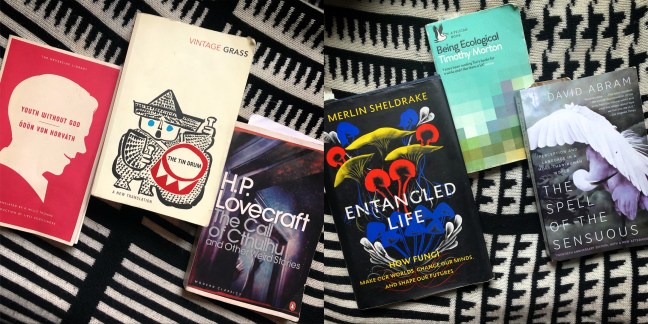
OK, I thought I’d share my recent and current reading. Starting with fiction.

Youth Without God (thanks Jono C-S for the recommendation) is fascinating read. Somewhat driven by ideas at the expense of character depth, it’s nonetheless powerful and evocative. Historically interesting too, and a disturbing window onto human behaviour as the Nazis gained power. Plenty of lessons for today.

Reading Youth Without God made me realise how little German literature I’ve read. Quite a few plays I suppose, but not many novels. Anyway… The Tin Drum has been on my reading list for yonks, so I finally got round to it. And yeah, what a wild ride. Incredible. Disturbing. Epic. Definitely joining its compatriot The Magic Mountain in my informal and unnumbered list of favourite ever books.

Continue reading Recent and Current Reading

Jeziorna, Galicia

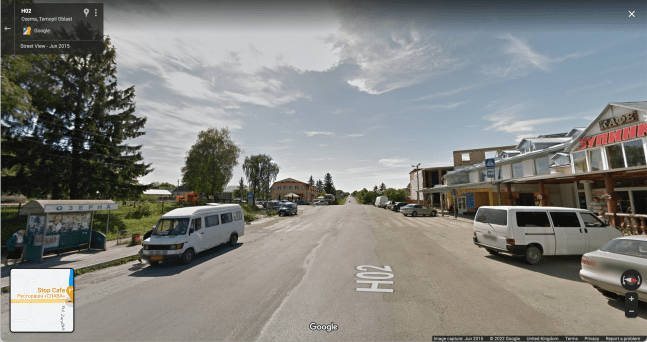
There’s a village I look at occasionally on Google Maps. I’ve even had a ‘walk’ up and down its main street, where there’s hardly anyone around and the sun is always out. A few places to eat and drink, a handful of shops. Lots of space. Lots of greenery. And because the land is flat and most the houses are single story, lots of sky.

It’s just 30 mins drive from Ternopil on the road to Lviv. Not the most direct route from Kyiv to the Polish border, but not too far out the way either. Ternopil has been in the news a little; people have fled to it, through it and from it. A great many people must have passed through this little village too, on their way westwards.

It’s the village my great grandfather came from, before he and his parents also headed west. For quite a while they lived here in Bethnal Green, which means I now live within a kind of invisible map of where that side of my family lived, worked, went to school…

Continue reading Jeziorna, Galicia

Some of my 2021 reading highlights

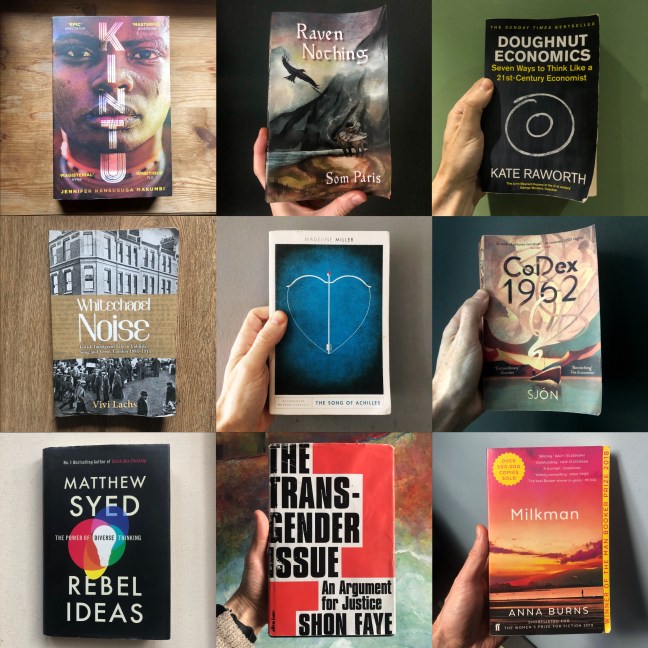
Here’s a partial selection of books I particularly loved or that made a deep impression on me in 2021. I’m not a fan of lists/favourites*… but I am a fan of sharing recommendations, so here we are.

The Quest for New England trilogy by Dark Age Voices would also be on this list, for teaching me about a whole part of history I knew almost nothing about, but eBooks don’t really go with the photo aesthetic. So here’s a link instead. I also read all but the last few pages of Som Paris’s book in 2020, so that might be cheating, but it’s great, so I don’t care. Raven Nothing is on one level a fantasy novel with a trans main character, but in fact explores ideas of transness in a much more interesting and complex way then that description suggests.

As for the other books, I’m not going to say a lot. Kintu is just a great story, brilliantly told. Doughnut Economics introduces a simple but brilliant idea that helps us look at economics through the lens of social and environmental justice, and also provides a really great potted history of economics. Whitechapel Noise is a bit more specialist but if you’re interested in what Yiddish songs tell us about life in Whitechapel in the late 19th and early 20th century – which I definitely am – this is the book. I don’t know what to say about The Song of Achilles. It spoke to me so deeply that I either say nothing or give it a blog post of its own.

Continue reading Some of my 2021 reading highlights