Maybe AI can save us (by accident)

Given the rapid growth of generative AI and society’s addiction to manipulative, corporately controlled online platforms, you might think this is the end of skilled creativity. If anyone can make a film or a song or a novel in seconds, what’s left for skilled artists and craftspeople? 

Well, quite a lot, I think. 

Yes, we need to fight tooth and nail against the wholesale theft of our work by tech corporations, the loss of livelihoods, and the flooding of culture with soulless, vacuous simulacrums of creativity. Let alone the ecological damage and data harvesting. But I keep thinking about how MP3s and file sharing were going to kill live music, which has, in fact, flourished. At the time, it felt that, after the initial excitement waned, the ubiquity of downloads ended up increasing the value of in-person experience. 

AI is now a spectacle in both the everyday and Debordian senses of the word. But as it is revealed as a kind centripetal force, pushing culture into smooth unoriginality, it will, I believe, remind us of our profound need for human community and connection, and for originality, creativity and craft. It will increase the cultural value of things evidently made by humans, using their skill and expressing something original, meaningful and authentic. It will help us appreciate the rough edges – the grit in the oyster – which allow art to take us to new and challenging places; places we didn’t expect to go.

That is good in itself and gives me hope for the creative sector, both professional and participatory, whether it’s live performance, art manifestly made by human hands, author readings and book signings, craft workshops, communal music-making and dancing… All the myriad points of creative connection that help hold society together.

But I have another hope, too; that if more and more people step away from the circus of corporate spectacle, see the atomised, narcissistic and easily exploitable society it fosters, and seek meaning and fulfilment through human creativity – especially co-creativity – we may also find we’re nurturing the conditions needed for meaningful, radical political change.

Generative AI and Nature Disconnection – some thoughts

I’m thinking a bit more about AI… and I’m no Luddite, by the way. I’ve been an early adaptor since Roydon County Primary School got its first computer sometime in the 80s. Also, to be clear, I’m aware that AI, as a tool in the right hands, has the potential for good. In medical diagnosis, for example.

But…

Generative AI is different from what’s gone before. There’s the extractivist theft from people who make a living from their creativity. And the enormous amount of carbon it emits. And, of course, the way it can be used to create fake news, manipulate voters, creep under the radar of broadcast regulators and fundamentally re-write our relationship with the truth. Not to mention how it exponentially increases the advantages of those privileged with access to tech. And the fact that it makes us more productive (in capitalist terms) at a time when we really need to learn how to celebrate and sustain what we already have. Oh, and the fact that, at some point, it’ll pass the Turing test, and we’ll have a massive ethical and legal dilemma on our hands. 

That, however, is not all.

This AI-generated dystopia sits within a much wider context of alienation and atomisation – from each other, from society and from nature – that has been gathering pace for centuries but has been accelerated by high-tech neoliberalism, from smartphones and Amazon to fake lawns, plastic-wrapped bananas and robot pets. 

Of course, some of these mod cons offer huge, even life-saving benefits to individuals with specific needs. But their cumulative effect on society leads to a kind of Nature disconnection. And that’s what I want to talk about because I think AI has the potential to accelerate this to a frightening degree.

Continue reading Generative AI and Nature Disconnection – some thoughts

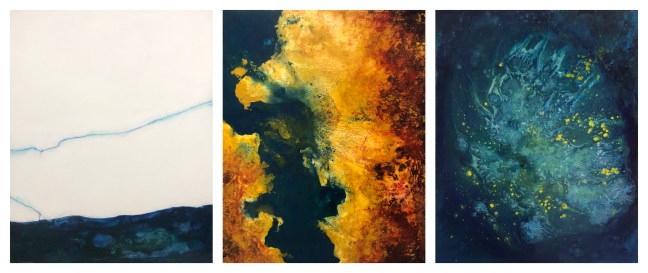
A climate triptych (and some thoughts on painting)

I take painting pretty seriously. It hugely informs my theatre design work, and I’ve frequently created video material from it. The work I did for the Dulwich Picture Gallery commission was a kind of digitally animated painting (involving a lot of very real painting on a wall). I’ve done several painting commissions. My first pocket money job was scenic painting at Harlow Playhouse.

Allow me a brief tangent, as I’ve just noticed a nice parallel. The pocket money job at Harlow Playhouse came about because I did work experience there aged 14. They must have liked what I did because occasionally, over the next few years, they got me in after school if they were short-handed on a paint call. My first properly paid work in theatre was, rather similarly, after doing a work placement. This was at Shakespeare’s Globe. They kept me on as an assistant in the wardrobe, where I worked on several ‘original practice’ techniques, including painstaking work slashing patterns in silk. I also helped source calico, silk, leather, pewter buttons and other period-appropriate items, and got an excellent working knowledge of London as a result. It was a really fantastic job, to be honest, and it led me eventually to design the sets for a full-scale Globe show.

Continue reading A climate triptych (and some thoughts on painting)

Bubble Dreams: the movie

Actually a lovely (and very short) film about how Carolyn Defrin and I made Bubble Dreams, an interactive video installation for Tessa Jowell Health Centre, London, commissioned by Dulwich Picture Gallery. Have a watch, and if you’re in the Dulwich area, pop in. It’s in the children’s waiting area; you’ll need to ask to be let in.

I can’t post this without also mentioning the amazing team we worked with: creative technologist Rob Hall, production manager Thomas Wilson, painting assistant Carly Brownbridge and children’s workshop leader Holly Dabs. Particular thanks also to Dulwich Picture Gallery’s Alexander Moore for being so supportive and maintaining such a good balance between the needs of the commissioner and artistic freedom.

What is Green Criticism?

The last time I was purposefully academic was probably when I sat my finals. Even then, we’d only been educated in the historical contexts of the writers we studied; there was little contemporary theory. Since then, I’ve taught at half a dozen universities at least, but always as a practitioner. Academically cutting edge I am not! But I do want to understand how the work I and my colleagues do in the arts fits with the urgent need, in the face of imminent climate breakdown, to view society as part of an ecological system. The question ‘what is green criticism?’ therefore seems to me to a pressing one. Green thought has provided us with a sophisticated analysis of society and its relationship to planet. How can we apply it to artistic practice?

Around the time I did my English degree, there were some books emerging that used ecology as way to approach literature: Jonathan Bate’s Romantic Ecology springs to mind, and Kim Taplin’s Tongues in Trees; I probably should re-read them. The aim of these books was to understand how writers related to nature: how ‘green’ they were. But that approach is about ecology; it’s not employing ecology as a critical tool. I wrote an extended essay in my third year about depictions of landscape in literature and painting at the time of the first generation Romantics. I was interested in the sublime and the beautiful, not out of any kind of swooning romanticism but because they suggest two ways of modelling our desire for the external. I’d noticed how some writers saw nature as a force that transformed the tiny figures traversing its landscapes, while some saw it as something that framed or provided a kind of extension to/illustration of heroic anthropocentrism. I was somewhat out on a limb, frankly. It probably wasn’t my best work. And it was also mainly ‘about’ the natural world. Yet it made me realise that there are analyses of nature which can – and probably should – be be applied to any kind of discourse.

So what might real green criticism be? Is anyone writing about how ecology could be a useful way to look at culture?  Continue reading What is Green Criticism?

Open Studio 2016: photos

My main occupation is scenography. I design sets, costumes and video for performance; mainly new writing and devised work. I love the collaborative nature of theatre but I think it’s important to maintain a personal fine art practice alongside it, not necessarily for public exhibition or sale but in order to keep asking myself who I am as an artist and what I have to offer my collaborators. So when it came to finding something to show at Bow Arts Open Studios 2016, I decided to share some of this work. Continue reading Open Studio 2016: photos

Dodgy Analogies, Dodgy Politics

The arts give society a space to think. Without them we are a golem: a figure of clay, subject to its master’s command, and deprived of the imaginative space necessary to relate meaningful to others and function in society.

OK. That’s an analogy with which you may or may not agree. It’s fairly useful as away to explain an idea that I personally find interesting. On the one hand, it’s way too reductive to be truthful in any philosophically helpful sense. It’s only of very limited use in explaining our need for the arts. Continue reading Dodgy Analogies, Dodgy Politics

A Bigger Splash: Painting after performance – a personal response

(Originally published in Blue Pages, the journal of The Society of British Theatre Designers)

Visiting A Bigger Splash: Painting after Performance, currently at Tate Modern, is an odd experience for a theatre designer. The exhibition interrogates the relationship between performance and painting – and, in fact, other visual media – from a variety of angles, sometimes tenuously but almost always in a way that is engaging and thought-provoking. However, it does this entirely within the frame of reference of visual art. It is as if performance outside the art gallery either does not exist or is merely a cultural phenomenon to be knowingly referenced; not a major group of art-forms that have their own evolutions, their own traditions and their own avant-garde movements. Yet we, as theatre designers, are engaging with many of the same issues as the artists in the exhibition, and with no less professionalism and integrity.

Continue reading A Bigger Splash: Painting after performance – a personal response

Visual artists as Theatre Designers: a response

(Originally published in Blue Pages, the journal of The Society of British Theatre Designers)

The original Guardian article, to which this responds, can be read here.

“Why don’t more visual artists do theatre?” This was the somewhat alarming headline introducing a Mark Lawson article in The Guardian in July. The piece itself was more nuanced. Crucially, he accepts that “stage design is clearly a form of art” and narrows “visual artists” down to “full-time painters and sculptors”. Nonetheless, there is something very fundamentally wrong with the underlying assumptions. I would argue that this is because we see ourselves not as jumped up scene painters, out of our depth in complexities of visual art, but as amphibians – operating fully in both visual and performance environments.

Continue reading Visual artists as Theatre Designers: a response