Dysbiosis in development

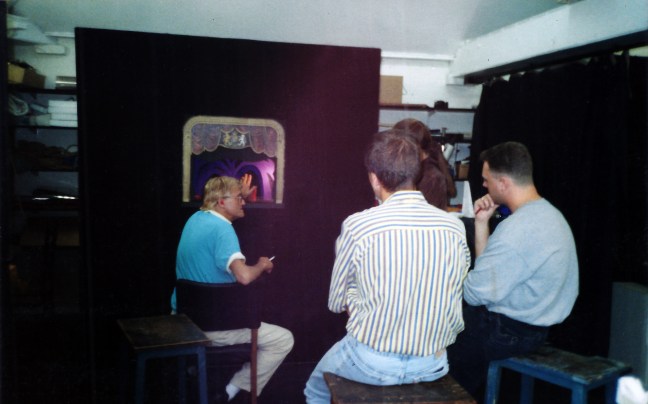
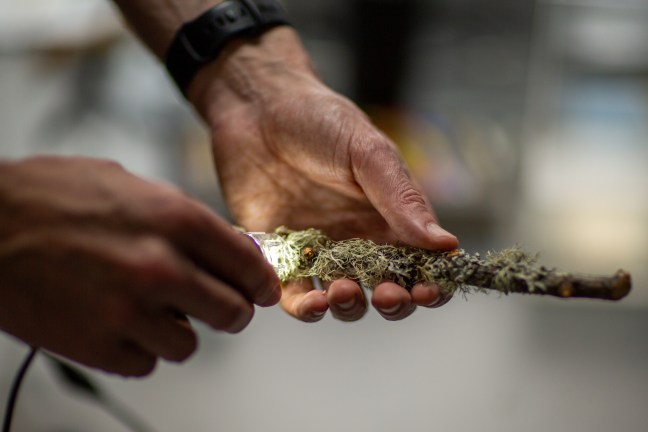
I was incredibly pleased with how this went. I had the idea just before Covid but then decided to step up and focus on promoting environmentally sustainable design in the theatre sector. Between the Society of British Theatre Designers working group, Ecostage and everything else, this has rather taken over my life! However, the reason I stick with a career in this precarious and often badly-paid sector – and the reason I want it to be sustainable in all senses of the word – is the creativity. Dysbiosis sits right on the overlap between ecology and art. Thanks to Queens generously giving us space, we did a week of experimentation with some really wonderful creative practitioners. Such a privilege!

Here’s a summary from the Daedalus website:

A call for collaborators

Queens Theatre Hornchurch, where I’m on the Environmental Responsibility Subcommittee, is committed to the idea that its journey towards environmental sustainability should be reflected in its creative output. As part of this, David Shearing led This Story is True for Most of Us as part last summer’s the Blueprint Festival. I was a creative associate on the project, which took a vegan meal on the theatre’s roof as a basis for an exploration of time, locality, ecology and – of course – our relationship with food.

Now QTH has given me space to start developing a new piece of theatre. I don’t know what the end result will be, except that it will be open, accessible and connected to the community. But I do know where we’re starting; by looking at our relationship with Nature through the lenses of language, culture and queer ecology. This is how I like to work, starting with research and, by applying my design process to the directing process, working collaboratively to find a logic and a shape to the piece.

Continue reading A call for collaborators

Recent and Current Reading

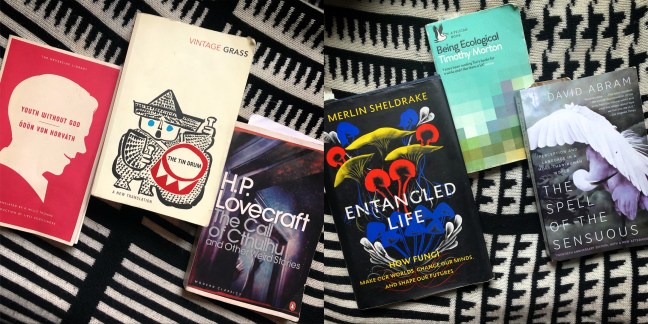
OK, I thought I’d share my recent and current reading. Starting with fiction.

Youth Without God (thanks Jono C-S for the recommendation) is fascinating read. Somewhat driven by ideas at the expense of character depth, it’s nonetheless powerful and evocative. Historically interesting too, and a disturbing window onto human behaviour as the Nazis gained power. Plenty of lessons for today.

Reading Youth Without God made me realise how little German literature I’ve read. Quite a few plays I suppose, but not many novels. Anyway… The Tin Drum has been on my reading list for yonks, so I finally got round to it. And yeah, what a wild ride. Incredible. Disturbing. Epic. Definitely joining its compatriot The Magic Mountain in my informal and unnumbered list of favourite ever books.

Continue reading Recent and Current Reading

Ecological Values

Given some of the awkward conversations I’ve had over the course of my career, I’ve added something to my website about my values, my expectations, and what I bring to the proverbial table. It’s very much a work-in-progress which I’ll doubtless keep refining. Do please feel free to let me know your thoughts!

Bubble Dreams: the movie

Actually a lovely (and very short) film about how Carolyn Defrin and I made Bubble Dreams, an interactive video installation for Tessa Jowell Health Centre, London, commissioned by Dulwich Picture Gallery. Have a watch, and if you’re in the Dulwich area, pop in. It’s in the children’s waiting area; you’ll need to ask to be let in.

I can’t post this without also mentioning the amazing team we worked with: creative technologist Rob Hall, production manager Thomas Wilson, painting assistant Carly Brownbridge and children’s workshop leader Holly Dabs. Particular thanks also to Dulwich Picture Gallery’s Alexander Moore for being so supportive and maintaining such a good balance between the needs of the commissioner and artistic freedom.

Fly, you fools! (or How Popular Culture Can Help Tell the Climate Crisis Story)

We win or lose through the stories we tell. They’re what changes the world. And the most important story we need to tell today is the one that gets the people of Planet Earth to take meaningful action on the ecological breakdown.

The stories we’re offering now, however, aren’t working.

It’s fine to tell those who respect science about how we’re on track for catastrophe, because they understand evidence. It’s fine to tell those already awake to social and environmental injustice how climate change is driven by our economic system and the power structures that maintain it, because that fits their existing worldview. But what’s the story for everyone else?

Humans are brilliant at denial. Being able to put aside thoughts of suffering and mortality, to compartmentalise and not feel everyone else’s suffering too deeply, helps keep us sane. It seems that’s how the majority of people respond when faced with the facts of impending apocalypse too, and it’s understandable. Climate change is deeply frightening and it’s coming at us like juggernaut with broken brakes.

Continue reading Fly, you fools! (or How Popular Culture Can Help Tell the Climate Crisis Story)

Environmental ethics and artistic practice: can they speak the same language? What does environmentally careful design look like?

This is the text I prepared for the above-named panel, at Making Theatre Green, at the National Theatre, London, 6th June 2022. What I actually said was inevitably a little different, but this version is clearer to read than a transcript with all my ums, errs, omissions and mistakes!


When I was around 12 or 13, I dug out my old Playmobil figures and made scale model sets for them. They’re quite close to 1:25, actually! I first painted the back wall of the school hall for a show when I was about 15. An early starter, you might think?

Well. According to a newspaper clipping, my mum found the other day, I got a brief write-up in the Harlow Star, aged 10, for saving up my pocket money to plant trees. 

And, frankly, it escalated from there.

So… I’ve been involved in environmental campaigning longer than I’ve been designing shows. But the crazy thing is how, until a few years ago, I totally compartmentalised the two.

Why did it take so long for me to bring these two obsessions together?

Continue reading Environmental ethics and artistic practice: can they speak the same language? What does environmentally careful design look like?

Jeziorna, Galicia

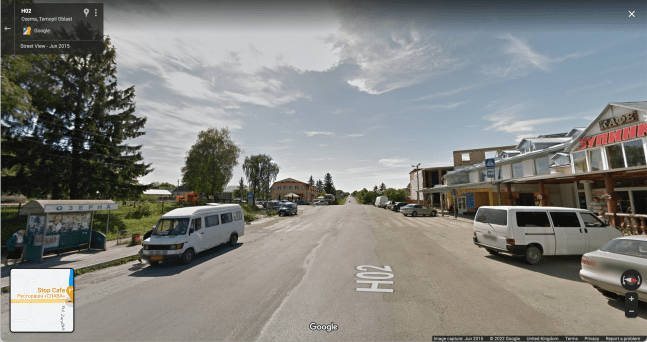
There’s a village I look at occasionally on Google Maps. I’ve even had a ‘walk’ up and down its main street, where there’s hardly anyone around and the sun is always out. A few places to eat and drink, a handful of shops. Lots of space. Lots of greenery. And because the land is flat and most the houses are single story, lots of sky.

It’s just 30 mins drive from Ternopil on the road to Lviv. Not the most direct route from Kyiv to the Polish border, but not too far out the way either. Ternopil has been in the news a little; people have fled to it, through it and from it. A great many people must have passed through this little village too, on their way westwards.

It’s the village my great grandfather came from, before he and his parents also headed west. For quite a while they lived here in Bethnal Green, which means I now live within a kind of invisible map of where that side of my family lived, worked, went to school…

Continue reading Jeziorna, Galicia

Some of my 2021 reading highlights

Here’s a partial selection of books I particularly loved or that made a deep impression on me in 2021. I’m not a fan of lists/favourites*… but I am a fan of sharing recommendations, so here we are.

The Quest for New England trilogy by Dark Age Voices would also be on this list, for teaching me about a whole part of history I knew almost nothing about, but eBooks don’t really go with the photo aesthetic. So here’s a link instead. I also read all but the last few pages of Som Paris’s book in 2020, so that might be cheating, but it’s great, so I don’t care. Raven Nothing is on one level a fantasy novel with a trans main character, but in fact explores ideas of transness in a much more interesting and complex way then that description suggests.

As for the other books, I’m not going to say a lot. Kintu is just a great story, brilliantly told. Doughnut Economics introduces a simple but brilliant idea that helps us look at economics through the lens of social and environmental justice, and also provides a really great potted history of economics. Whitechapel Noise is a bit more specialist but if you’re interested in what Yiddish songs tell us about life in Whitechapel in the late 19th and early 20th century – which I definitely am – this is the book. I don’t know what to say about The Song of Achilles. It spoke to me so deeply that I either say nothing or give it a blog post of its own.

Continue reading Some of my 2021 reading highlights

Lockdown update

(Top photo: Kenny Baraka with DJ Conrad Kira in Plot 17. Photo: Suzi Corker)

I was asked to summarise, briefly, what I got up to during lockdown. But I couldn’t. It was too varied, and lots of things required some explanation. I guess everyone knows that the theatre sector has been hit very hard by the pandemic. Many workers have left to get sensible, less precarious, less stressful jobs. I haven’t. But I have, as they say, diversified. Perhaps, I thought to myself, that’s worth a blogpost. So here goes.

Myself, Andrea Carr and Mona Kastell at the Ecostage Launch, CCA Glasgow, during COP26. (Photo: Kanatip Soonthornrak)

To start with, I used the opportunity afforded by the Self-Employment Income Support Scheme to help set up the Society of British Theatre Designers’s first working group on sustainability, taking on the role of co-ordinator. I also become one of the directors of Ecostage, an initiative for supporting ecological thinking in the performing arts. Along with Andrea Carr, Mona Kastell, Ruth Stringer and some volunteers, I helped rebuild the project from the ground up as a go-to platform for green-minded performing arts professionals. The new website, ecostage.online, was launched at COP26 last month. Various other advisory roles then followed, including helping gather material for The Green Book, joining the advisory panel on sustainability for the Queens Theatre Hornchurch and informally helping co-ordinate knowledge-sharing with other sustainable performing arts groups around the world. 

In the past I’ve joked that, because of the huge disconnect between workload and pay in the sector, my ideal working model would be to get some kind of stipend, then offer my services for free as I see fit. SEISS felt a bit like that, and for a while I was almost a full-time volunteer.

Continue reading Lockdown update