Does environmentalism transcend left and right?

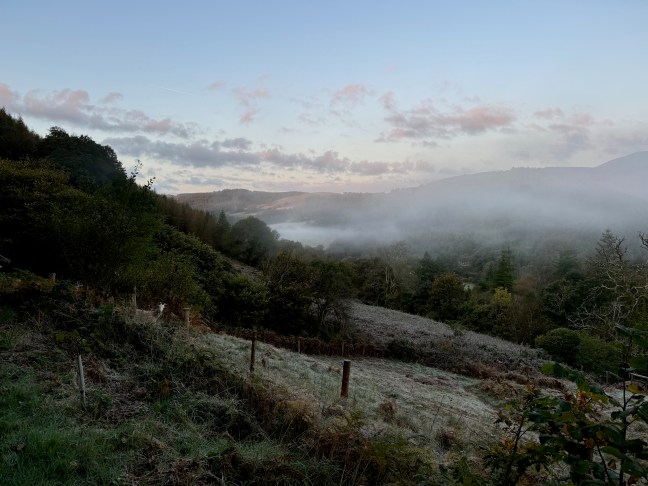
A view of hills shrouded by cloud, with a patch of early-morning sunlight, and a goat in the foreground

Back in the 90s when, as a teenager, I was first getting into green politics, it was often said that green would transcend the ‘grey’ politics of left and right. You don’t hear that much any more. Maybe we should. Is right-wing environmentalism part of the answer to the multiple ecological crises the world faces? Can we meaningfully create a consensus outside our socio-economic political differences and find ways to work together?

I’ve been thinking about this a lot recently because of a discussion on the topic I was part of. I will boil the conversation down to its two main arguments. The proposition, as it were, is that we exist in a bubble of other like-minded, progressive, evidence-led people while, in the wider world, people are falling for dishonest and divisive far-right rhetoric. It is as if we live in separate universes with entirely different understandings of reality. The counterargument is to acknowledge that people on the right also care about the environment – some of them, at least – and start to build a consensus that transcends the old left-right binary. You can have right-wing and left-wing environmental politics. Rightwing environmentalism might look like Tories caring about the countryside, for example, or eco-fascism, or a belief that capitalism will come up with a green technofix.

Continue reading Does environmentalism transcend left and right?
Generative AI and Nature Disconnection – some thoughts

I’m thinking a bit more about AI… and I’m no Luddite, by the way. I’ve been an early adaptor since Roydon County Primary School got its first computer sometime in the 80s. Also, to be clear, I’m aware that AI, as a tool in the right hands, has the potential for good. In medical diagnosis, for example.

But…

Generative AI is different from what’s gone before. There’s the extractivist theft from people who make a living from their creativity. And the enormous amount of carbon it emits. And, of course, the way it can be used to create fake news, manipulate voters, creep under the radar of broadcast regulators and fundamentally re-write our relationship with the truth. Not to mention how it exponentially increases the advantages of those privileged with access to tech. And the fact that it makes us more productive (in capitalist terms) at a time when we really need to learn how to celebrate and sustain what we already have. Oh, and the fact that, at some point, it’ll pass the Turing test, and we’ll have a massive ethical and legal dilemma on our hands. 

That, however, is not all.

This AI-generated dystopia sits within a much wider context of alienation and atomisation – from each other, from society and from nature – that has been gathering pace for centuries but has been accelerated by high-tech neoliberalism, from smartphones and Amazon to fake lawns, plastic-wrapped bananas and robot pets. 

Of course, some of these mod cons offer huge, even life-saving benefits to individuals with specific needs. But their cumulative effect on society leads to a kind of Nature disconnection. And that’s what I want to talk about because I think AI has the potential to accelerate this to a frightening degree.

Continue reading Generative AI and Nature Disconnection – some thoughts

Update on my sustainability work (and other things)

As many of you will know, I’ve been prioritising my work on sustainability recently. Building on the voluntary work for Ecostage and the Society of British Theatre Designers that I’ve been doing since before the pandemic, I’m now nearly halfway through a part-time MSc at the Centre for Alternative Technology.

I look forward to having more availability for design work next year, and applying the sustainability principles and practices I’ve been learning and developing. In the meantime, as some of you haven’t heard from me in a while, I’d like to share an update.

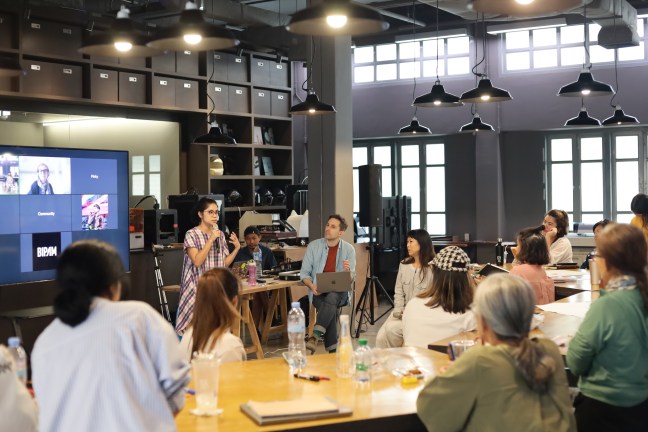
Working with the SBTD and Footprint Scenery, I co-organised and co-facilitated Makers and Designers Assemble! at the National Theatre. As the title suggests, this event brought theatre designers and makers together to talk about how better to support each other’s efforts to work in a more environmentally responsible way. There was a particular emphasis on circular economy; in fact, the event was part of Circular Economy Week. It started some exciting conversations beyond the event itself… which was precisely the aim!

Continue reading Update on my sustainability work (and other things)

Recent and Current Reading

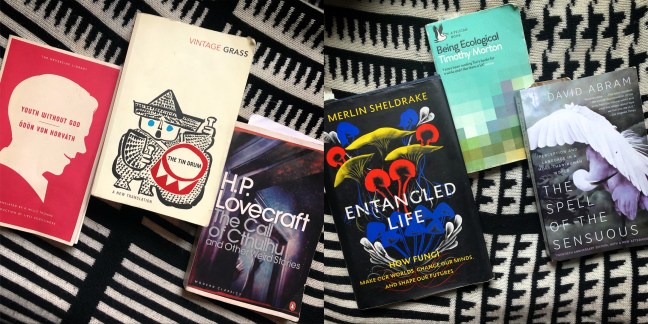
OK, I thought I’d share my recent and current reading. Starting with fiction.

Youth Without God (thanks Jono C-S for the recommendation) is fascinating read. Somewhat driven by ideas at the expense of character depth, it’s nonetheless powerful and evocative. Historically interesting too, and a disturbing window onto human behaviour as the Nazis gained power. Plenty of lessons for today.

Reading Youth Without God made me realise how little German literature I’ve read. Quite a few plays I suppose, but not many novels. Anyway… The Tin Drum has been on my reading list for yonks, so I finally got round to it. And yeah, what a wild ride. Incredible. Disturbing. Epic. Definitely joining its compatriot The Magic Mountain in my informal and unnumbered list of favourite ever books.

Continue reading Recent and Current Reading

Ecological Values

Given some of the awkward conversations I’ve had over the course of my career, I’ve added something to my website about my values, my expectations, and what I bring to the proverbial table. It’s very much a work-in-progress which I’ll doubtless keep refining. Do please feel free to let me know your thoughts!

Environmental ethics and artistic practice: can they speak the same language? What does environmentally careful design look like?

This is the text I prepared for the above-named panel, at Making Theatre Green, at the National Theatre, London, 6th June 2022. What I actually said was inevitably a little different, but this version is clearer to read than a transcript with all my ums, errs, omissions and mistakes!


When I was around 12 or 13, I dug out my old Playmobil figures and made scale model sets for them. They’re quite close to 1:25, actually! I first painted the back wall of the school hall for a show when I was about 15. An early starter, you might think?

Well. According to a newspaper clipping, my mum found the other day, I got a brief write-up in the Harlow Star, aged 10, for saving up my pocket money to plant trees. 

And, frankly, it escalated from there.

So… I’ve been involved in environmental campaigning longer than I’ve been designing shows. But the crazy thing is how, until a few years ago, I totally compartmentalised the two.

Why did it take so long for me to bring these two obsessions together?

Continue reading Environmental ethics and artistic practice: can they speak the same language? What does environmentally careful design look like?